


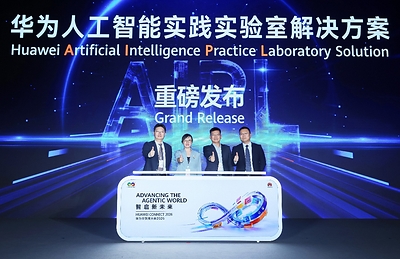
During HUAWEI CONNECT 2026, the Global Education Summit themed “AI × Education: Building the Talent Foundation for the Digital & Intelligent Era” took place in Shanghai. At the event, Huawei officially announced the global launch of its AI Practice LAB (AIPL) Solution and concurrently released the “AI+ Practical Teaching White Paper.” The initiative directly targets a growing structural bottleneck across higher education: conventional academic coursework remains heavily weighted toward abstract theory, leaving students unprepared for the hands-on engineering demands of the artificial intelligence industry.

TL;DR

- Global Launch: Huawei introduced its AI Practice LAB (AIPL) Solution and released the “AI+ Practical Teaching White Paper” at HUAWEI CONNECT 2026 in Shanghai.
- Core Philosophy: The solution focuses on three operational pillars—real-world scenarios, real data, and real algorithms—bringing industrial case studies and engineering tools into higher education.
- Academic Deployment: Built in partnership with 12 baseline partners, AIPL has already rolled out across institutions such as Beijing Institute of Technology and Shanghai Jiao Tong University.
- Guiding Framework: The accompanying white paper introduces a multi-tier reference architecture for universities, spanning curriculum restructuring, four-dimensional evaluation, and a five-party ecosystem.
Addressing the Divide Between Academic Theory and Industry Needs

As artificial intelligence transformation accelerates across global industries, traditional teaching methodologies struggle to keep pace. Conventional computer science and data science curricula often emphasize conceptual lectures and static assignments. However, deploying machine learning and deep learning systems in enterprise environments demands practical proficiency with messy real-world datasets, complex model architectures, and production-grade engineering toolchains.
To address this capability gap, Huawei developed the AIPL Solution using its accumulated cross-industry deployment experience. The architecture centers on three foundational principles: real-world scenarios, real data, and real algorithms. By integrating anonymized industrial data, actual enterprise use cases, and specialized engineering utilities into university laboratory sessions, AIPL enables academic institutions to cultivate artificial intelligence specialists who are immediately aligned with workforce requirements.
University Deployments and Ecosystem Collaboration
Huawei reported that the AIPL Solution was constructed in collaboration with 12 baseline industry and academic partners. The platform has already transitioned from pilot demonstrations into concrete deployments at several prominent institutions, including Beijing Institute of Technology and Shanghai Jiao Tong University.
The formal global launch ceremony at the summit brought together senior leadership from both industry and academia. The initiative was unveiled jointly by Li Junfeng, Vice President of Huawei and CEO of the Global Public Sector Business Unit; Pang Chuanchun, Director of Huawei's Learning & Certification Services Department; He Lian, Vice President of Wuhan University; and Xue Guangtao, Director of the Network & Information Center of Shanghai Jiao Tong University. Through this international rollout, Huawei aims to promote practical AI pedagogical models across academic institutions worldwide.
Leadership Insights: Engineering Bridges for Scientific Innovation
Speaking at the summit, Tao Jingwen, Deputy Chairman of the Supervisory Board at Huawei, emphasized the collaborative imperative behind modern educational reform. Tao noted that together with the education sector and industrial enterprises, Huawei has integrated AI technologies to deepen the exploration of practical training models.
Tao described these efforts as building “roads” and “bridges” across theoretical learning, hands-on practice, and scientific research innovation. He further stated that Huawei will remain deeply rooted in the education sector, adopting an open model to collaborate with universities, research institutions, and industry partners to drive digital and intelligent transformation through technological innovation.
The “AI+ Practical Teaching White Paper” Framework
Alongside the AIPL platform rollout, Huawei teamed with academic institutions and global education organizations to publish the “AI+ Practical Teaching White Paper.” The publication was formally witnessed by a delegation of academic and industry representatives, including:
- Du Min, President of Huawei Higher Education BU
- Sun Gang, Director of Huawei's ICT Talent Partner Development Dept
- Zhang Jianjun, Vice President of Huawei
- Bi Xiaohan, Deputy Director of the UNESCO International Centre for Higher Education Innovation
- Xia Zhengwei, Vice Director of the Information Center of Wuhan University
- Li Kangju, President of the Shenyang Institute of Technology
- Lu Jie, Deputy Director of BGI College
The white paper systematically examines the theoretical reasoning and practical methods required to restructure higher education talent cultivation in the intelligence era. Focusing specifically on the integration of AI within practical pedagogy, the document puts forward a comprehensive reference framework defined by five interconnected dimensions: one foundation, two types of elements, three levels of courses, four-dimensional evaluation, and a five-party ecosystem.
According to the publication announcement, this framework is intended to serve as a pragmatic, systematic guide for university administrators, teaching faculty, educational researchers, and enterprise stakeholders seeking to modernize AI curricula.
Future Expansion Across Academic Disciplines
Looking ahead, Huawei stated it will continue partnering with academic institutions to reinforce the digital and intelligent foundations of education. The company plans to replicate the AIPL instructional model across diverse disciplines, converting commercial business scenarios and advanced technical toolchains into shared resources for smart campuses, smart teaching environments, practical laboratory modules, and collaborative research innovation.
Frequently Asked Questions
What is Huawei's AI Practice LAB (AIPL) Solution?
The AIPL Solution is an educational platform designed by Huawei to modernize artificial intelligence education. Built around real-world scenarios, real data, and real algorithms, it incorporates anonymized enterprise data, actual business use cases, and engineering software into university coursework to bridge the divide between theoretical study and industry requirements.
Where and when was the AIPL Solution announced?
The solution was officially unveiled globally on September 21, 2026, during the Global Education Summit at HUAWEI CONNECT 2026 in Shanghai.
Which academic institutions are already utilizing the AIPL platform?
Developed alongside 12 baseline partners, the AIPL platform has already been deployed at several higher education institutions, including Beijing Institute of Technology and Shanghai Jiao Tong University.
What core framework is proposed in the “AI+ Practical Teaching White Paper”?
The white paper outlines a structured transformation roadmap for higher education institutions based on five structural components: one foundation, two types of elements, three levels of courses, four-dimensional evaluation, and a five-party ecosystem.
Who collaborated on the release of the white paper?
The white paper was released by Huawei in partnership with universities and industry partners, with representatives witnessing the launch from organizations including the UNESCO International Centre for Higher Education Innovation, Wuhan University, Shenyang Institute of Technology, and BGI College.


0 Comments