


TL;DR
- Petabit-Scale Milestone: Meta has announced Petal, the world’s first transoceanic subsea cable engineered to transmit 1 petabit per second (Pbps)—or 1,000 terabits per second—doubling the capacity of current state-of-the-art transatlantic cables.
- Transatlantic Route & Timeline: Spanning approximately 7,000 kilometers (4,300 miles) between the United States and France, the cable system is projected to enter commercial service in 2029.
- Multi-Core Fiber at Scale: Petal is the first subsea project to deploy multi-core fiber (MCF) technology commercially, using 24 fiber pairs of dual-core strands to achieve the throughput of a 48-fiber-pair system while remaining within standard 18 kV power limits.
- Key Industrial Partners: The project is being constructed in partnership with turnkey system provider NEC Corporation, fiber manufacturer Sumitomo Electric Industries, and landing partner Orange.
In a major development for international telecommunications, Meta announced Petal on September 21, 2026, describing it as the world’s first petabit-class transoceanic subsea cable system. Spanning roughly 7,000 kilometers (4,300 miles) across the Atlantic Ocean between France and the United States, Petal is engineered to deliver an aggregate capacity of 1 petabit per second (Pbps)—equivalent to 1,000 terabits per second.
To illustrate the scale of 1 Pbps, Meta stated that this bandwidth roughly equals the transmission capacity required for 75 percent of the global population—approximately 6.25 billion people—to stream 160 kbps audio simultaneously. Scheduled to enter service in 2029, Petal represents the single largest generational capacity increase for a repeatered subsea cable system in telecommunications history.
Overcoming the Physical Limits of Subsea Cables

Subsea optical cables remain the foundational yet largely invisible backbone of the global internet, carrying approximately 99 percent of all intercontinental data traffic. Since the introduction of the erbium-doped fiber amplifier (EDFA) in the late 1980s and the transition to coherent transmission technologies in the 2010s, subsea cables enjoyed more than a decade of tenfold capacity gains. Eventually, however, single-fiber throughput encountered the Shannon Limit—the theoretical upper threshold of error-free data transmission across a physical communication channel.
To bypass this barrier, network operators adopted Spatial Division Multiplexing (SDM), which expands total capacity by adding more optical fibers into a single undersea cable rather than attempting to overdrive individual fibers. Over recent years, Meta’s subsea investments systematically scaled this architecture:
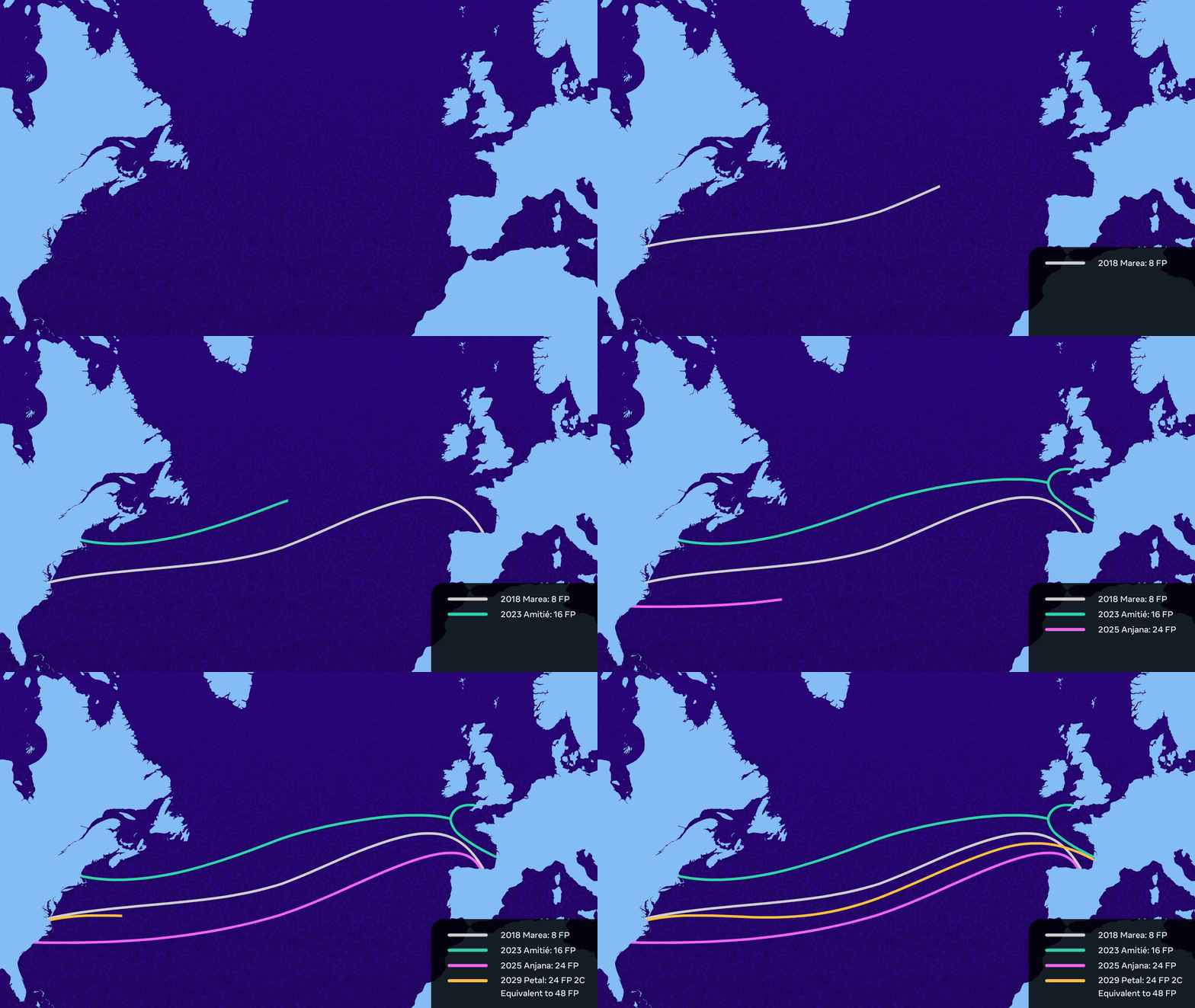
- Marea: Deployed with 8 fiber pairs.
- Amitié: Expanded to 16 fiber pairs.
- Anjana: Scaled to 24 fiber pairs, becoming the first 0.5 Pbps transatlantic system.
Petal delivers 5.5 times the capacity of Marea and doubles the throughput of Anjana, establishing a new operational benchmark for transoceanic data movement.
Inside the Multi-Core Architecture: Doubling Fiber Density
When planning how to double cable throughput beyond Anjana’s 0.5 Pbps, Meta engineers considered three engineering pathways:
- Continuing on the conventional SDM path by doubling the strand count to 48 single-core fiber pairs.
- Expanding into the optical L-band alongside the conventional C-band (C+L transmission across 24 fiber pairs), similar to the design of the Pacific Light Cable Network (PLCN).
- Transitioning to multi-core fiber (MCF) technology using dual-core strands.
Meta opted for the multi-core approach, deploying 2-core fibers within a 24-fiber-pair configuration to achieve the operational capacity of 48 fiber pairs. By condensing a petabit of throughput into a single cable jacket, the system reduces the raw materials, deployment vessels, and overall carbon footprint required compared to laying two separate 0.5 Pbps cables.
Solving Attenuation and Inter-Core Crosstalk
Commercializing multi-core fiber across 7,000 kilometers of deep-sea conditions introduced two rigorous optical physics challenges: maintaining ultra-low signal attenuation without expanding the standard fiber diameter, and preventing inter-core optical crosstalk.
Standard subsea fibers are manufactured to an outer cladding diameter of 125 micrometers (μm)—roughly the thickness of a human hair. Fiber supplier Sumitomo Electric Industries met this dimensional constraint while preserving signal clarity by manufacturing preforms out of ultra-pure synthetic silica. These glass cylinders, initially measuring 20 centimeters wide and 2 to 3 meters long, are drawn into thousands of kilometers of 125 μm dual-core fiber.
To address crosstalk—where light signals traveling through adjacent cores leak into one another—engineers implemented high refractive index differentials between the cores and surrounding cladding. Furthermore, optical signals are counter-propagated in opposite directions along adjacent cores, reducing cross-core interference to practically immeasurable levels and matching the performance of single-core glass.
96-Amplifier Repeaters: Single-Body Efficiency Under 18 kV
Optical signals traversing thousands of kilometers through oceanic depths weaken over distance, requiring periodic amplification. In a typical 7,000-kilometer cable, approximately 100 underwater repeaters are spliced along the route at regular intervals.
To amplify 96 optical cores across 24 dual-core fiber pairs without creating bulky, unmanageable submerged housings, NEC and Meta designed a specialized single-body 96-amplifier repeater. The system relies on a Fan-In/Fan-Out (FIFO) optical interface:
- As the dual-core fiber enters the repeater housing, the FIFO interface splits each strand into two separate single-core optical paths.
- Signals are boosted using established, high-reliability single-core erbium-doped amplification paired with an SDM pump-sharing architecture.
- Once amplified, the FIFO recombines the signals back into the 2-core fiber structure before exiting to the ocean floor.
This design allows Petal to double transoceanic capacity without a proportional spike in electrical demand. Petal operates within existing subsea power feeding equipment (PFE) parameters, which are rated up to 18 kilovolts (kV). Staying within the 18 kV threshold eliminates the need to redesign and requalify the wider high-voltage subsea supply ecosystem.
Consortium Partnerships: NEC, Sumitomo Electric, and Orange
Building Petal relies on a global industrial partnership uniting Japanese telecommunications manufacturers and European network providers:
NEC Corporation: Acting as the turnkey system supplier, NEC qualified and engineered the entire petabit SDM foundation—including the cable assembly, repeaters, FIFO units, and electrical powering architecture. NEC also manages manufacturing and final deep-sea marine installation.
“Achieving petabit-per-second capacity across a transoceanic submarine system represents a major technological milestone in the history of global telecommunications. This achievement reflects NEC’s sustained investment in research and development, combined with decades of experience delivering some of the world’s most advanced, reliable, and secure submarine networks that interconnect the globe,” stated Eduardo Mateo, Chief Strategy Officer of NEC Corporation’s Submarine Network Division.
Sumitomo Electric Industries: Serving as the fiber supplier, Sumitomo Electric manufactured the dual-core “2C Z-PLUS ULL Fiber” with ultra-low attenuation and counter-propagating isolation.
“We are thrilled that Sumitomo Electric’s innovative submarine multi-core fiber, ‘2C Z-PLUS ULL Fiber’ will contribute to ‘Petal’, an epoch-making Pb-class transatlantic cable system. As a pioneer with nearly four decades of experience in ultra-low loss submarine fiber manufacturing, we are committed to supporting the global network expansion essential to realizing a highly digital future,” said Takehiko Okada, General Manager of the Optical Fiber & Cable Division at Sumitomo Electric Industries.
Orange: The telecommunications group is partnering with Meta to land the cable on France’s Atlantic coast and manage the terrestrial network interconnection into mainland Europe.
“Reaching one petabit on a transatlantic link, 25 years after the terabit milestone, represents a significant breakthrough to meet the exponential traffic growth while optimizing network capacity. This makes us very proud to welcome this new generation petabit subsea cable with dual-core fiber technology in our infrastructure, as the landing party in France,” stated Jean-Louis Le Roux, Executive Vice President of Orange International Networks.
What Petal Means for Global Connectivity
Meta’s Petal initiative transitions multi-core fiber from laboratory trials into commercial-scale subsea deployment. As intercontinental data demands continue to surge, deploying multi-core fiber within established mechanical and electrical boundaries provides a sustainable roadmap for future transoceanic cables.
With an anticipated launch in 2029, Petal is positioned to establish a new technological baseline for global connectivity, demonstrating how intelligent optical design can double undersea network density while controlling capital, material, and environmental costs.
Frequently Asked Questions
What is Meta’s Petal subsea cable?
Petal is a transatlantic subsea fiber optic cable announced by Meta that delivers 1 petabit per second (Pbps) of transmission capacity over approximately 7,000 kilometers (4,300 miles), connecting France and the United States.
When is the Petal subsea cable expected to go live?
According to Meta, the Petal subsea cable system is scheduled to enter commercial service in 2029.
How does Petal achieve petabit capacity?
Petal deploys 2-core multi-core fiber across a 24-fiber-pair cable configuration, providing the capacity equivalent of 48 fiber pairs within a standard 125-micrometer fiber diameter. Signal amplification is handled by single-body repeaters using Fan-In/Fan-Out (FIFO) interfaces and pump-sharing technology.
Who is building and landing Petal?
Meta is developing Petal in partnership with NEC Corporation as the turnkey system supplier, Sumitomo Electric Industries as the multi-core fiber manufacturer, and Orange as the landing and terrestrial interconnection partner in France.
Does Petal require higher electrical voltage to operate?
No. Petal is engineered to remain within existing subsea power feeding equipment limits rated up to 18 kV, avoiding the need to requalify power systems across the subsea ecosystem.


0 Comments