

TL;DR

- Milestone Orbital Attempt: SpaceX is preparing the 14th integrated test flight of its 124-meter (407 ft) Starship-Super Heavy vehicle, targeting its first orbital insertion after 13 previous suborbital flights.
- Next-Gen Payload: The mission, designated Starlink 31-1, carries 26 Starlink Version 3 satellites, with three units equipped with dedicated cameras to monitor Starship's heat shield tiles.
- Hardware Profile: Powered by Super Heavy Booster 21 and Ship 41 from Pad 2 at Starbase; neither stage will be recovered during this test.
- Mission Profile: If the 25-minute orbital insertion burn is executed, deployment will span roughly 30 minutes, followed by six orbits around Earth and a controlled ocean splashdown off South America nearly ten hours after liftoff.
Historic Milestone: Starship Prepares for Its First Orbital Flight

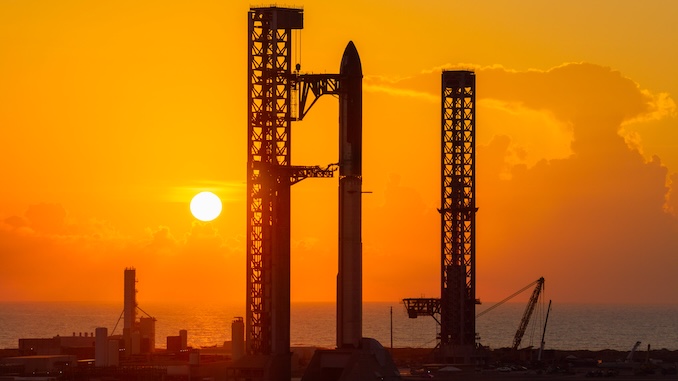
SpaceX is poised to launch its massive Starship-Super Heavy rocket toward orbit for the first time in program history on Monday, September 28, 2026. Standing 124 meters (407 feet) tall at Pad 2 of the company's Starbase facility, the towering launch vehicle represents the largest and most powerful rocket ever developed. The flight attempt arrives precisely 18 years after SpaceX's first launch vehicle, the Falcon 1, reached orbit for the first time in 2008.

Designated officially as the Starlink 31-1 mission, the launch represents the 14th flight test of the integrated Starship and Super Heavy vehicle. Unlike the previous 13 missions—which were intentionally flown on suborbital trajectories to test vehicle aerodynamics, staging, and thermal protection boundaries without entering full orbit—Flight 14 aims to place the upper stage into an operational Earth orbit.
Liftoff is scheduled within a 75-minute launch window opening at 7:15 a.m. CDT (8:15 a.m. EDT / 1215 UTC), according to launch schedules reported by Spaceflight Now.
Flight 14 Architecture: Booster 21, Ship 41, and Engine Reignitions
The mission pairs two distinct vehicle segments: first-stage Super Heavy booster B21 and the Starship upper stage, S41. In contrast to select previous tests that evaluated booster return dynamics, SpaceX will not attempt to recover either stage during this flight test.
Engineers will closely evaluate vehicle health and telemetry during ascent and the initial coast phase. Reaching orbit requires a critical maneuver known as an orbital insertion burn. In spaceflight mechanics, a rocket must not only climb above the atmosphere but also attain sufficient horizontal speed to enter a sustainable orbit. Approximately 25 minutes after liftoff, Ship 41 is scheduled to reignite one of its three sea-level Raptor engines. This brief burn is designed to raise the vehicle's perigee and circularize its trajectory into a stable orbit around Earth.
SpaceX has established a conditional flight plan: if mission operators opt not to perform the orbital insertion burn, the vehicle will continue along a suborbital trajectory consistent with prior test flights.
Payload Deployment: The Debut of Starlink Version 3
Should Ship 41 successfully complete its orbital insertion maneuver, the mission will transition to deploying its primary payload: 26 Starlink Version 3 satellites. This marks the inaugural orbital delivery of SpaceX's next-generation satellite constellation hardware aboard Starship.
Satellite deployment is planned to begin roughly 34 minutes after liftoff. The release sequence will unfold over approximately 30 minutes, with the 26 satellites dispensing from Ship 41 at roughly one-minute intervals. While SpaceX previously indicated that future operational Starship flights could carry up to 60 Starlink V3 satellites, the company opted to fly a reduced complement of 26 units for this maiden deployment mission.
In-Orbit Thermal Shield Inspection
Beyond network communications, three of the 26 Starlink V3 satellites feature specialized imaging hardware. These cameras are configured to capture high-definition video of Ship 41's thermal protection tiles while in orbit. Monitoring the integrity of the heat shield tiles under true orbital conditions provides critical engineering feedback on tile bonding, mechanical stresses, and thermal behavior before atmospheric re-entry.
Orbital Journey, Controlled Re-Entry, and Future Catch Plans
Under the orbital flight profile, Ship 41 will complete approximately six revolutions around Earth. Nearly nine hours after liftoff, the spacecraft will execute a precise 11-second deorbit burn to lower its orbital path and initiate atmospheric re-entry.
The maneuver will position Ship 41 for a planned, controlled splashdown in the ocean off the western coast of South America approximately one hour following the deorbit burn. This extended flight allows SpaceX to collect comprehensive telemetry on upper-stage thermal systems, attitude control, and guidance software across multiple orbits.
The data gathered from Flight 14 is poised to directly influence upcoming milestones in SpaceX's rapid development roadmap. SpaceX confirmed that, depending on the results and performance of this mission, the company may attempt to catch the Starship upper stage with the launch tower arms during the subsequent Starship Flight 15.
Frequently Asked Questions
What makes Starship Flight 14 different from earlier Starship flights?
While the previous 13 flights followed suborbital flight trajectories, Flight 14 is the first attempt in Starship program history to achieve a sustained orbit around Earth and deploy operational satellites.
What payload is on board Starship Flight 14?
The rocket carries 26 next-generation Starlink Version 3 satellites. Three of these satellites are equipped with specialized imaging systems to inspect the spacecraft's heat shield tiles.
Will SpaceX recover the rocket stages on this flight?
No. SpaceX will not attempt to recover either the Super Heavy Booster 21 or the Starship Ship 41 upper stage on this mission.
Where will Ship 41 land after completing its orbital test?
After completing approximately six orbits, Ship 41 will perform an 11-second deorbit burn and execute a controlled splashdown in the ocean off the western coast of South America.
When could SpaceX attempt to catch the Starship upper stage?
SpaceX stated that depending on the outcome of Flight 14, it may attempt to catch the Starship upper stage during Flight 15.


0 Comments